Laser cladding machines

Laser cladding machines for shafts, rollers and moulds.

NEOClad laser cladding systems from Monoline Laser & Robotics fuse a hard, wear-resistant metal layer onto new parts and rebuild worn ones, so they return to service instead of being scrapped.

  • 6, 8, 10 and 12 kW options
  • 0.1–1.5 mm layer per pass
  • Workpieces up to 6000 mm long
  • Tropicalised, up to 48 °C
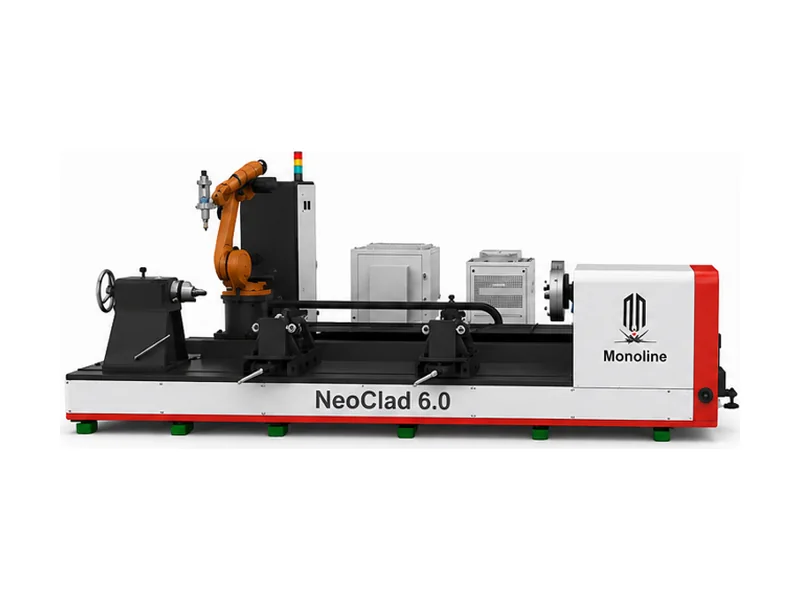
NEOClad laser cladding machine
NEOClad

Laser cladding machine for shafts, rollers and moulds

NEOClad systems add a harder metal skin to new parts and rebuild worn ones so they go back into service.

NEOClad laser cladding machine
Laser cladding

NEOClad

Laser cladding for shafts, rollers and molds, in 6, 8, 10 and 12 kW.

  • Series NEOClad 6.0 / 8.0 / 10.0 / 12.0 (6–12 kW)
  • Supports fiber and diode lasers
  • High powder utilisation, multi-functional design
Specifications

NEOClad technical data

From our published specification sheet.

NEOClad laser cladding machine specifications
ParameterNEOClad
SeriesNEOClad 6.0 / 8.0 / 10.0 / 12.0
Laser power6–12 kW (fiber or disc laser)
Laser typeFiber-coupled, beam quality ≤ 8 mm·mrad
Cladding thickness0.1–1.5 mm per pass
Powder feed typeDual-cylinder pneumatic or gravity-fed
Powder size range20–300 µm
Max powder feed rate150–200 g/min
Powder feed accuracy≤ ±1%
Workpiece lengthUp to 6000 mm
Max clamping diameterΦ630–Φ800 mm
Max rotating diameterΦ800–Φ1500 mm
Rotary table load2–15 tons
Robot payload25–30 kg (6-axis industrial robot)
CNC travel (X/Y/Z)1500 / 2500 / 800 mm
CoolingIntegrated chiller (primary/secondary)
Power supply3-phase, 380–415 V, 50/60 Hz
SafetyClass 1 enclosure, interlocks, laser viewing windows
Software3D path generation, hybrid welding integration
Ambient conditionsUp to 48 °C, 85% RH (tropicalised)
How it works

How laser cladding works

Powder is blown into the laser spot and fused to the part, giving a thin, hard, metallurgically bonded layer.

  1. FeedA nozzle blows metal powder (typically 20–300 µm) into the laser spot at up to 150–200 g/min, controlled to better than ±1%.
  2. FuseThe laser melts the powder and only a very thin skin of the base metal, so dilution stays low and the layer stays hard and pure.
  3. BuildThe head moves while the part rotates or the table moves. Tracks overlap to form a dense layer of 0.1–1.5 mm per pass.
  4. MachineThe layer is ground or turned to final size. The bond is metallurgical, so it does not peel like plating or spray coatings.

Read the full laser cladding lesson →

Why cladding

Laser cladding compared with other methods

Choose by duty: wear, heat or corrosion resistance.

01

Versus plating or thermal spray

These form a mechanical bond that can chip or peel. Cladding is fused to the base metal.

02

Versus arc weld overlay

Arc overlay brings more heat and distortion and thicker, rougher layers. Cladding is thinner, more precise and distorts less.

03

Less waste

Thin controlled layers save powder and machining time, and worn parts are rebuilt instead of scrapped.

Applications

What laser cladding is used for

Repair and protect high-value parts.

  • Shafts
  • Rollers
  • Moulds and dies
  • Wear-resistant coatings
  • Corrosion-resistant coatings
  • Heat-resistant coatings
  • Rebuilding worn parts
FAQ

Frequently asked questions

What is laser cladding?

Laser cladding adds a new, harder metal layer onto the surface of a part. A laser melts metal powder together with a very thin skin of the base metal, so the new layer is fused to the part. It is used to harden new parts and to rebuild worn shafts, rollers and moulds.

What power range do NEOClad machines cover?

The NEOClad series is available as 6.0, 8.0, 10.0 and 12.0, which means 6 to 12 kW using a fiber or disc laser.

How thick is a laser cladding layer?

0.1 to 1.5 mm per pass. Extra passes build thicker coatings.

How long a workpiece can the machine handle?

Up to 6000 mm in length, with a maximum clamping diameter of Φ630 to Φ800 mm depending on the configuration.

Is the NEOClad suitable for Indian conditions?

The specification lists tropicalised operation up to 48 °C and 85% relative humidity, with an integrated chiller and a 3-phase 380 to 415 V supply.

Which powder should I use?

The powder decides the result. Common families are nickel-, cobalt- and iron-based alloys, sometimes with hard carbide particles. Tell us the part and the failure you want to fix and we will advise.

How do I get a quote for a laser cladding machine?

Use the quote form, call +91 7594 998 159 or ask MonoBot. Please share the part size, material and what you want to protect or rebuild.
Laser welding, laser cladding and metal 3D printing machines, plus fiber laser source repair. Built in Ahmedabad, India.

Pages

Home Company Products Industries Technology Gallery Request a quote Contact

Products & Services

Laser Welding Machines Laser Source Repair Laser Cladding Machines Metal 3D Printers Laser Marking & Custom Machines Machine Software

Contact

Ahmedabad, Gujarat, India
View on Google Maps ↗

+91 7594 998 159 info@monolinelaser.com

Business Hours

Monday – Saturday
9:30 AM – 6:30 PM

© 2026 Monoline Laser and Robotics Machinery Pvt. Ltd.